
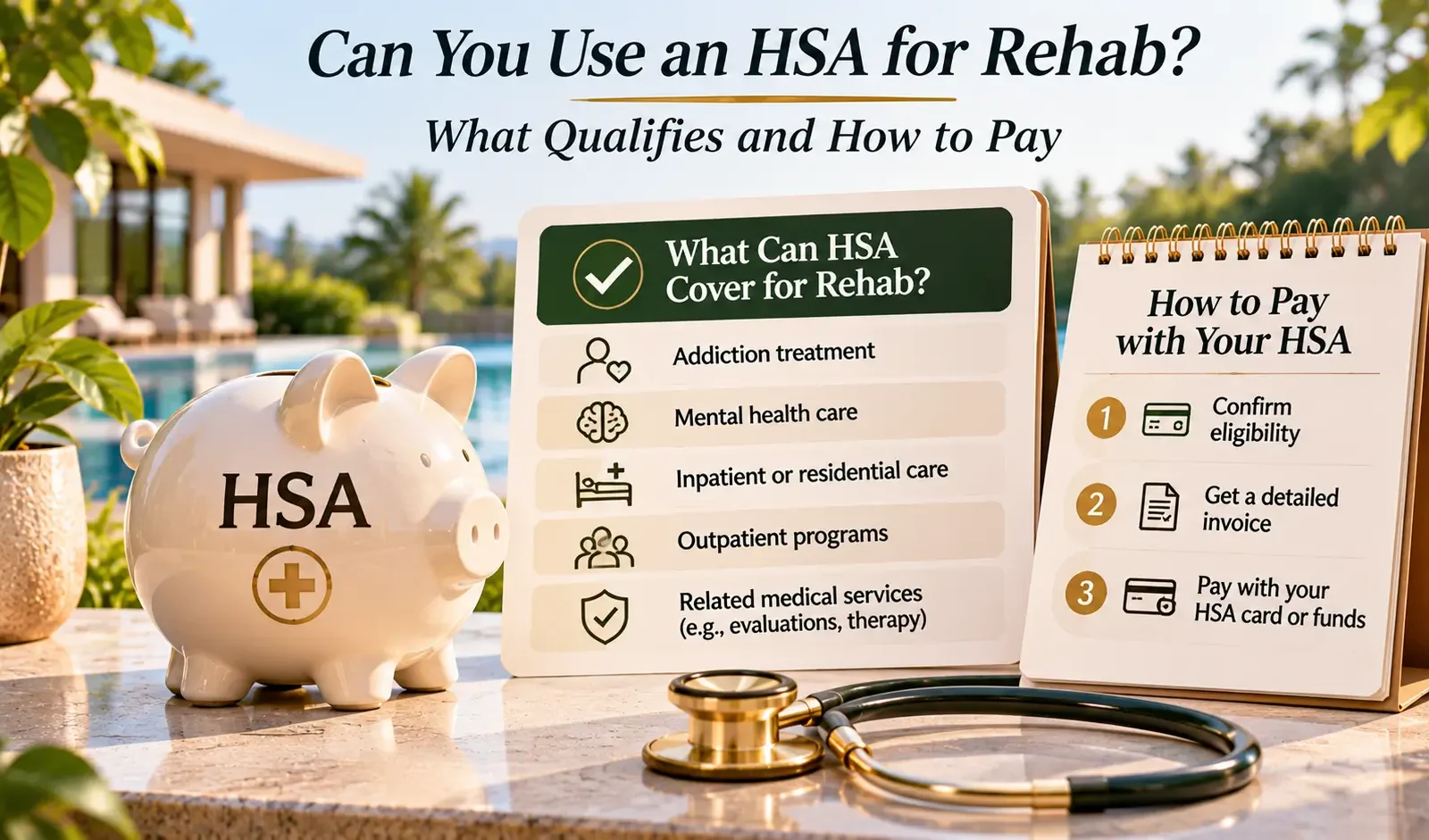
If you have money set aside in a health savings account, it may cover more of treatment than you expect.
Can you use an HSA for rehab? Yes. The IRS treats addiction treatment as medical care, so HSA funds can usually pay for detox, inpatient and outpatient programs, therapy, and medication, including meals and lodging during inpatient treatment. The cost must be incurred after your HSA was set up, and you should keep every receipt.
We are a treatment provider, not tax advisors, so use this guide as a starting point and confirm details with your HSA administrator or a tax professional.
Key takeaways:
- You can use an HSA for rehab costs such as detox, residential care, and therapy, tax-free.
- Meals and lodging count when they are part of inpatient treatment at the center.
- Extras billed separately, such as spa services, usually do not qualify.
- You can pay now and reimburse yourself later, as long as your HSA existed when the cost was incurred.
- An HSA can also pay for a spouse’s or dependent child’s treatment.
If you plan to pay for some or all of treatment yourself, our guide to private pay luxury rehab explains your other options.
What rehab costs can an HSA pay for?
HSA rules follow the IRS definition of medical care. IRS Publication 502 lists inpatient treatment at a therapeutic center for alcohol or drug addiction as a medical expense, including meals and lodging the center provides during treatment.
| Cost | Usually HSA-eligible? | Notes |
|---|---|---|
| Medical detox | Yes | Part of treating addiction |
| Inpatient or residential treatment | Yes | Includes meals and lodging provided by the center during treatment |
| Partial hospitalization and intensive outpatient | Yes | Treatment costs qualify |
| Therapy and counseling | Yes | When it treats a diagnosed condition, including substance use and mental health |
| Prescription medication | Yes | Including medicines used to treat addiction |
| Travel to treatment | Often | Transportation mainly for medical care can qualify |
| Deductibles, copays, and coinsurance | Yes | The share your insurance does not pay |
| Sober living | Sometimes | Some administrators ask for a letter of medical necessity |
| Amenities billed separately | Usually not | Such as spa treatments or personal training |
Your HSA administrator makes the first call on a claim, so check its eligibility list before you pay a large bill.
Does an HSA cover the amenities at a luxury rehab?
Partly. When you stay at a treatment center for care, the IRS counts the center’s meals and lodging as part of the medical expense. Lodging provided as part of inpatient care generally qualifies, though an administrator may question charges that look like optional upgrades.
Services that are billed separately and are not medical care, such as spa treatments, relaxation massage, or personal training, usually do not qualify. Some may qualify if a clinician documents that they treat a diagnosed condition.
Ask the program for an itemized bill that separates clinical care, room and board, and optional extras. That makes your claim easier to support. Our guide to luxury rehab cost explains what usually drives the price.
What rules do you need to follow?
Using an HSA for rehab is simple if you follow a few rules:
- The cost must come after your HSA was set up. Costs incurred before the account was established do not qualify, even if you pay them later.
- The money does not have to be in the account yet. You can pay another way and reimburse yourself later, with no deadline, as long as you keep records.
- Do not pay for the same cost twice. Skip anything insurance already paid or that you deduct on your tax return.
- Keep every receipt and itemized bill. You do not send them with your return, but you need them if the IRS asks.
- Avoid non-qualified spending. HSA money used for other costs is taxed as income, plus an extra 20% tax unless you are 65 or older or disabled.
IRS Publication 969 explains these rules in full.
What if you’re no longer eligible to contribute?
You can only add money to an HSA while you are covered by a high-deductible health plan and have no other disqualifying coverage, such as Medicare. If you lose eligibility, the money already in your account is still yours. You can keep using it tax-free for qualified medical costs, including rehab.
HSA vs FSA vs HRA: which can you use for rehab?
All three accounts can pay for qualified addiction treatment, but they work differently.
| Feature | HSA | Health FSA | HRA |
|---|---|---|---|
| Who owns it | You | Your employer’s plan | Your employer’s plan |
| Who adds money | You, your employer, or others | You, and sometimes your employer | Your employer |
| Unused money | Rolls over every year | Usually lost at year end, with limited carryover or a grace period on some plans | Depends on the employer’s rules |
| When money is available | As it is deposited | The full yearly amount, from the start of the plan year | Set by the employer |
| If you change jobs | You keep it | Usually lost | Usually lost |
The health FSA rule is worth knowing. If you chose an FSA amount at open enrollment, you can usually use the full year’s amount early in the year, even before it has all come out of your pay.
Employers set some FSA and HRA rules, so ask HR whether residential treatment is covered. Our insurance coverage guide explains how employer plans fit in.
Do you need a letter of medical necessity?
Often not for standard addiction treatment, but some administrators ask for one. This is more common for sober living, holistic therapies, or services that could also be used for general wellness.
A letter of medical necessity is a note from a licensed provider explaining that a service treats a diagnosed condition. Ask your administrator before you pay. If a letter is needed, the program’s clinical team can usually provide one.
How do you use an HSA for rehab, step by step?
Follow these steps to keep your claim clean:
- Check your balance and the date your HSA was established.
- Ask your HSA administrator whether residential treatment and sober living are eligible under its rules.
- Ask the program whether it accepts HSA debit cards, and request an itemized estimate.
- Pay with your HSA card, or pay another way and reimburse yourself later.
- Save receipts, itemized bills, and any letter of medical necessity.
If you also have health insurance, check what your plan covers first. Your HSA can then pay your deductible, copays, and coinsurance. Our guide on how to read your insurance verification results explains those terms.
Need help right now? Call our admissions team at (754) 283-6425. If anyone is in immediate danger, such as an overdose or a medical emergency, call 911.
Planning to use HSA funds for treatment? Our admissions team can give you an itemized estimate and explain which costs are clinical care and which are extras. Our number is in the last section of this guide.
Is rehab tax deductible?
Yes, when it is medically necessary and you are not reimbursed for it. You can include addiction treatment in itemized medical expenses on Schedule A, but only the part of your total medical costs above 7.5% of your adjusted gross income is deductible.
You cannot deduct anything you paid with HSA or FSA funds, because that money was already tax-free. Therapy for a diagnosed condition can also count as a medical expense. A tax professional can tell you whether itemizing makes sense for you.
Frequently asked questions
Can I use my HSA for my child’s rehab?
Yes, if your child is your tax dependent. HSA funds can pay a dependent’s qualified medical costs even if the child is not covered by your high-deductible plan. Rules can differ for divorced or separated parents, so check with a tax professional.
Can I use my HSA for therapy after rehab?
Yes, in most cases. Therapy for a diagnosed condition, including substance use and mental health conditions, is a qualified medical expense. Our list of questions to ask your insurer about rehab can help you check what your plan covers first.
Can I reimburse myself later?
Yes. There is no deadline, as long as the cost came after your HSA was established and you kept the receipts. Some people call this the HSA reimbursement loophole, but it is simply how the rules work.
Can I open an HSA now and use it for rehab I’ve already started?
Only for costs incurred after the account is established. Earlier treatment costs do not qualify, but later costs, such as continuing care or aftercare, may.
Can family members add money to my HSA?
Yes. Anyone can contribute to your HSA, but all contributions count toward your yearly limit.
Table of Contents
Want help planning how to pay for treatment?
Working out what your HSA, insurance, and savings will cover can feel like a lot when you are trying to get help. Our admissions team can explain our costs, give you an itemized estimate, and walk you through how our program works.
Call (754) 283-6425 to talk it through, or verify your insurance online to see what your plan may cover first.
Questions are welcome, whether or not you are ready to choose a program.




1 Comment